
Table of Contents
- What Food Photography Pricing for Restaurants Actually Covers
- Restaurant Photography Rates: Hourly, Day, and Half-Day
- Food Photography Pricing Per Dish and Per Image
- What Restaurant Photography Packages Include
- Food Photography Usage Rights and Licensing, Explained
- Beginner, Mid-Level, and Professional Photographer Rates
- How to Budget for Recurring Content and Measure Return
- Frequently Asked Questions
Last Updated: October 5, 2026
What Food Photography Pricing for Restaurants Actually Covers
Food photography pricing for restaurants is the total cost a restaurant pays a professional photographer to plan, shoot, edit, and license images of its menu items, cocktails, interiors, and team.
Most restaurant owners ask one question first: what will this actually cost us? Pricing depends on scope, and any photographer who quotes a flat number before asking about your menu is guessing.
The five pricing models restaurant clients encounter are hourly, half-day, day rate, per-dish, and per-image.
Restaurant photography pricing is not a single number. It is a scope decision. Get the scope right and the price becomes predictable.
Restaurant Photography Rates: Hourly, Day, and Half-Day
Restaurant photography rates usually fall into three time-based structures: hourly, half-day, and full-day. Hourly works for small jobs like a single signature cocktail or a headshot.
An hourly rate makes sense when the shoot is short and tightly defined, one dish, one drink, or one interior corner.
Half-day and day rates spread that overhead across more images. According to U.S. Small Business Administration guidance on pricing services, service businesses typically price by the value delivered and the time required, not by the hour alone.
Why Day Rates Beat Hourly Rates on Multi-Dish Shoots
Day rates beat hourly rates on multi-dish shoots because setup, styling, and lighting costs are paid once instead of repeatedly. On a ten-dish shoot, the first dish might take 40 minutes to light and style, while the tenth takes ten.
There is a second reason most restaurant owners miss: on a day rate, the photographer has room to shoot variations, the hero angle, a top-down, a close-up of texture, a lifestyle shot with hands in frame.
Ask any photographer how many dishes they can realistically capture in a half-day versus a full day. The answer tells you more about their process than any rate sheet. A tight operator will give you a specific number, not a range.
Food Photography Pricing Per Dish and Per Image
Food photography pricing per dish and per image is the model most restaurant clients find easiest to budget against.
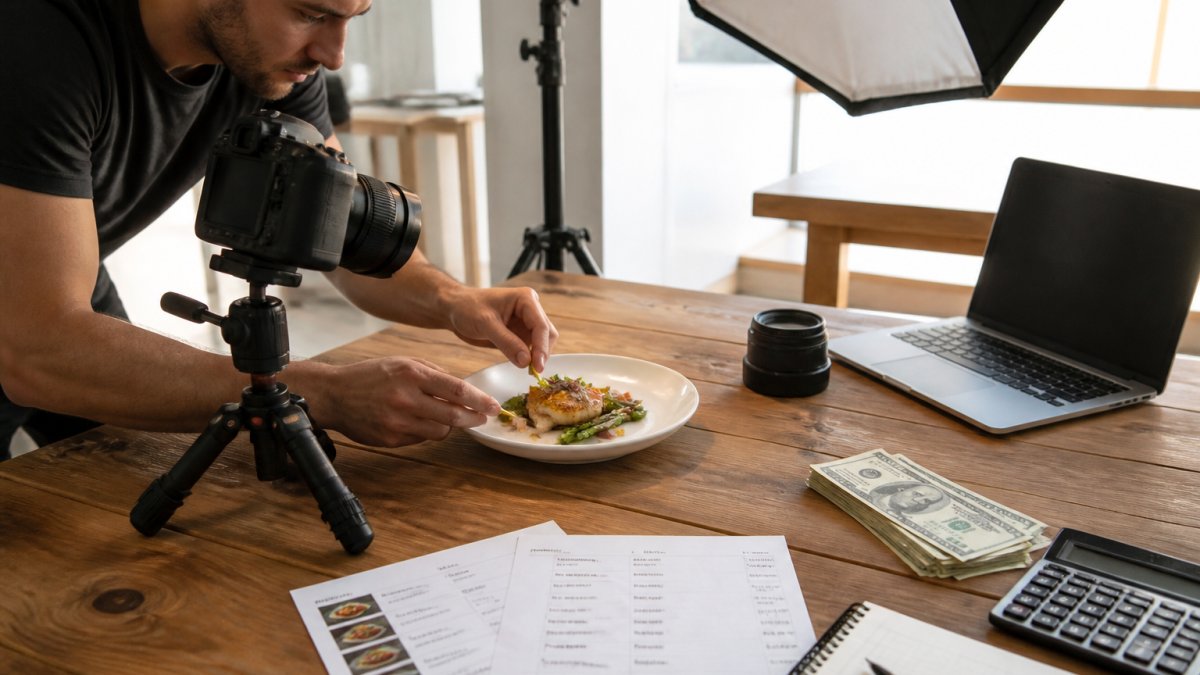
Per-dish pricing bundles the whole process for one menu item: styling, lighting, multiple angles, and a set number of edited finals.
| Pricing Model | Best For | What Drives the Number |
|---|---|---|
| Hourly | Single dish, drink, or interior | Time on site |
| Half-day | 5-10 dishes or a small menu section | Dish count and setup |
| Day rate | Full menu, multiple setups | Scope and shot list |
| Per-dish | Menu refresh, delivery app listings | Number of dishes |
| Per-image | Hero shots, ad campaigns | Number of edited finals |
How Dish Count Drives the Final Quote
Dish count drives the final quote because every additional item adds styling, plating, and lighting time. A photographer shooting eight dishes will not simply double their output for sixteen. They will need more time, more styling support, and more editing hours.
This is where a restaurant-specific quote template earns its keep. Instead of asking “what do you charge,” give the photographer a structured brief:
- Number of dishes and drinks to be photographed
- Number of final edited images needed per dish
- Usage: menu, delivery apps, social, paid ads, or print
A brief like this turns a vague conversation into a scoped quote and protects you from scope creep, because both sides agreed on the dish count up front.
What Restaurant Photography Packages Include
Restaurant photography packages bundle shoot time, styling, editing, and a set number of deliverables into one price.
For an established restaurant, a menu package covers the full food and drink list, plus interior photography and a handful of lifestyle frames.
For a food hall or multi-location group, a content package adds recurring shoots: a set number of new images and short-form video clips delivered every month, keeping social feeds fresh without a scramble before every launch.
Food Photography Usage Rights and Licensing, Explained
Food photography usage rights determine where, for how long, and in what media you can use the images you paid for.
The cleanest way to think about it: you are not buying the photos. You are buying permission to use them. The U.S. Copyright Office overview of photography and licensing is the right starting point for what a license does and does not transfer.
How Each Channel Changes the Price
Most photographers price licensing by channel because each carries different commercial value and risk, grouping uses into tiers rather than quoting every channel separately.
| Channel | Typical License Tier | Why It Prices That Way |
|---|---|---|
| In-store menu and printed materials | Base | Limited audience, no ongoing distribution |
| Own website and organic social | Base | Standard marketing use, no paid spend behind it |
| Delivery platforms (DoorDash, Uber Eats, Grubhub) | Mid | Third-party commercial use, long shelf life, drives direct orders |
| Email and SMS marketing | Mid | Direct-response use tied to revenue |
| Paid social and search ads | Higher | Media spend amplifies the image’s commercial reach |
| Billboards, transit, print campaigns | Higher | Broad public distribution, long exposure |
| Third-party or franchise licensing | Highest | The image travels beyond your own brand |
The logic is straightforward: the more commercial value the image generates and the further it travels from your own channels, the higher the license tier. A hero shot of your signature dish on your website is a different product from the same file running in a paid campaign across three platforms for a year.
The Five Terms to Nail Down Before You Sign
- Scope of use: Which channels are covered, and which are explicitly excluded? If delivery platforms are not named, assume they are not included.
- Duration: How long does the license run, one year, three years, perpetual? What happens at renewal, and is there a renewal fee?
- Territory: Where can the images appear? A single-market restaurant and a multi-state group need different terms.
What “Perpetual” and “Unlimited” Actually Mean
Two words cause most of the confusion. “Perpetual” refers to duration, the license does not expire. “Unlimited” refers to volume, no cap on impressions or placements. Neither word automatically includes every channel.
When a photographer offers a perpetual, unlimited license at no extra cost, ask which channels are inside the scope. Most base licenses are perpetual for owned channels and time-limited for paid and third-party use, because paid campaigns have a defined run and budget behind them.
How to Budget for Licensing Without Overpaying
Match the license to the actual plan, not a worst-case scenario. If you are not running paid ads this quarter, do not buy the paid-ad tier yet, most photographers will let you upgrade later for a defined fee, keeping the initial quote lean.
A practical approach:
- List every channel you will use the images on in the next 12 months.
- Separate owned channels (menu, website, organic social) from commercial channels (delivery platforms, paid ads, print).
- Ask for the license priced by tier, not as a single bundled number, so you can see what each channel adds.
- Confirm in writing what happens if you want to add a channel mid-license.
A quote that says “full usage” without naming channels is not a license, it is a placeholder. Get the channel list, the duration, and the territory in writing before the shoot, not after.
Beginner, Mid-Level, and Professional Photographer Rates
Photographer rates track experience, portfolio depth, and how much of the process the photographer handles alone.
Beginners are usually building a portfolio and may offer lower rates in exchange for access to your venue and menu.
Mid-level photographers have a working portfolio of restaurant work and a repeatable process, a shot list, a lighting plan, a turnaround commitment.
Professionals bring full production: pre-production planning, food and prop styling, on-site direction, post-production retouching, and licensing paperwork.
The most expensive shoot is the one you have to redo. A low rate that produces images you cannot use on your delivery listings costs more than a properly scoped shoot at a higher rate.
How to Budget for Recurring Content and Measure Return
Budgeting for recurring content means treating photography as a monthly line item, not an annual splurge. Restaurants that post consistently need fresh imagery every month, and a recurring package spreads that cost predictably instead of concentrating it into one painful invoice.
The first step is to stop budgeting from a single number and start budgeting from a quote structure. Every restaurant photography quote, whether one-time or recurring, breaks into the same line items. Once you can see them, you can plan.
The Itemized Quote Structure
A transparent quote separates planning, production, post-production, licensing, and expenses. Here is the structure to ask for, with what each line covers:
| Line Item | What It Covers | How It Scales |
|---|---|---|
| Pre-production | Shot list, mood board, scheduling, location scouting | Flat per shoot |
| Shoot time | Half-day or full-day rate on site | By time block |
| Food and prop styling | Stylist time, props, surfaces, backgrounds | By dish count or day |
| Editing and retouching | Culling, color, cleanup, per-image retouch | By final image count |
| Licensing | Channel tiers (menu, web, social, delivery, paid) | By channel and duration |
| Travel and location | Mileage, parking, studio rental if applicable | By distance or venue |
| Expenses | Groceries for hero dishes, prop purchases, rentals | Pass-through with receipts |
| Rush or turnaround | Expedited delivery before a launch | Percentage uplift |
When a quote arrives as a single number, ask for it broken into these lines. Photographers who work with restaurants regularly already quote this way, and the breakdown protects both sides: you see what you are paying for, and the photographer has a documented scope if the dish count grows mid-shoot.
Retainer Math for Monthly Shoots
A retainer is a recurring package priced below the sum of its individual shoots, because the photographer gets predictable volume and you get a predictable rate. Most restaurant retainers follow one of three rhythms:
- Monthly: One half-day or full-day shoot per month, covering new menu items, seasonal specials, and a set number of social frames.
- Quarterly: A larger shoot every three months, sized to cover a full menu refresh plus a content bank for the weeks between.
- Seasonal: Four shoots a year aligned to menu changes, with a defined image count per shoot.
The retainer discount is real but modest, typically a percentage off the equivalent one-off rate, not a fraction of it. The bigger value is scheduling: a retainer locks your shoot dates before the photographer’s calendar fills, which matters most before a menu launch or holiday push.
What to Count Before You Commit
Start by counting what you actually need per month: new menu items, seasonal specials, cocktails, team shots, and short-form video for social. Then match that count to a package tier.
A simple planning rule: budget for the images you will actually post, not the images you hope to post. If your social calendar calls for 12 posts a month and you reuse each image twice, you need roughly six new finals per month, plus a bank for launches.
Measuring Return Without a Data Team
Measuring return is where most restaurants stop short. Track these before and after a shoot:
- Delivery app conversion: Compare tap-through rates on listings with new photography versus old. This is usually the fastest signal, because delivery platforms show you the impressions and the taps.
- Reservation volume: Watch for changes in bookings in the weeks after a menu refresh.
- Social engagement: Track saves and shares, not just likes, on new image posts. Saves are the closest proxy for intent.
- Ad performance: Compare click-through rates on paid campaigns using new versus old creative.
- Menu item mix: If a newly photographed dish starts showing up more in orders, the image is doing work on the menu itself.
None of these require a data team. A simple spreadsheet updated monthly will show whether your photography spend is pulling its weight. If reservations and tap-throughs move after a refresh, the imagery is doing its job.
For a market-specific view, restaurant industry performance data from the National Restaurant Association is a useful benchmark for how your venue compares to broader trends.
Ask your photographer for a sample itemized quote before you commit to a retainer. The structure of the quote tells you more about how they work than any rate sheet.
Frequently Asked Questions
How much do restaurants pay for food photography?
There is no single national rate. What a restaurant pays depends on the number of dishes, shoot duration, deliverables, editing, and usage rights. A short menu refresh covering a handful of items sits at the low end, while a full menu plus cocktail and interior coverage with broad licensing sits at the high end. Ask each photographer for an itemized quote showing day rate, per-dish fees, retouching, and licensing separately so you can compare like for like.
Should restaurant food photography be priced by the hour, by the dish, or by the project?
All three models exist, and the right one depends on scope. Hourly rates suit small shoots with a fixed shot list. Per-dish pricing works when you know exactly how many menu items need coverage. Project or package pricing fits full menu refreshes, seasonal campaigns, and multi-location work because it bundles shoot time, food styling, editing, and licensing into one number. Ask for the model that matches your scope, then compare the total cost per usable final image.
Do food photography rates include editing and image usage rights?
Not always, and this is where quotes diverge most. Some rates cover the shoot only, with editing and licensing billed separately. Others bundle a set number of retouched images plus defined usage rights. Food photography usage rights determine where you can run the images: menus, delivery apps, social media, paid ads, or print. Confirm in writing how many final images you receive, how much retouching is included, and which channels the license covers before you sign.
How can restaurants compare food photography quotes fairly?
Break every quote into the same four lines: shoot time, number of dishes and final edited images, retouching scope, and usage rights. Add travel and any kitchen rental or prop styling costs. Then divide the total by the number of usable final images to get a true cost per image. A lower headline rate with limited licensing or few edited files often costs more once you license extra channels or book a second shoot.